Welding procedure specifications

Welding procedure software built around ISO 15609-1

A welding procedure specification is only useful if it carries everything the standard asks for. This page sets out what ISO 15609-1:2019 requires in a WPS, clause by clause — and shows you the software that captures it, versions it, and prints it in two languages.

What a WPS is — and what it is not

A welding procedure specification (WPS) is the document that tells a welder how to make a specific weld: which process, which consumable, which current, which preheat. ISO 15609-1 does not tell you how to weld. It tells you what has to be written down, because those are the variables that change the quality of the finished joint.

A preliminary WPS (pWPS) is the same document before it has been qualified. You weld a test piece to it, test the results, and the outcome is recorded in a welding procedure qualification record (WPQR) — under ISO 15614 for the ISO route, or a PQR under ASME IX. The qualified WPS then references that record. The general rules for that route live in ISO 15607, not in 15609-1.

ISO 15609 has five parts, one per process family. Part 1 covers arc welding and is the one that applies to MMA, MIG/MAG, TIG, SAW and plasma. Gas welding, electron beam, laser beam and resistance welding are covered by parts 2 to 5.

What ISO 15609-1:2019 requires in a WPS

Clause 4 of the standard sets out the technical content. It is grouped below the way it is actually filled in, not the way it is numbered. Ranges and tolerances have to be stated wherever they are relevant — a WPS covers a range of conditions, not one point. For some jobs the list can be extended or reduced.

This is a summary written for orientation. The authoritative text is ISO 15609-1:2019, available from ISO.

Content required in every welding procedure specification
GroupWhat the WPS has to stateClause
IdentificationThe manufacturer, the WPS reference, and a link to the WPQR or other qualifying document4.2
Parent materialMaterial designation and its reference standard; the material group number (ISO/TR 20172, 20173 or 20174 — or ISO/TR 15608 if the material is not assigned in those). One WPS may cover a whole group4.3.1
DimensionsThickness range of the material; outside diameter range for pipe4.3.2
ProcessThe welding process, designated to ISO 40634.4.1
PositionThe welding positions, to ISO 69474.4.3
Joint designA sketch of the joint and its dimensions, or a reference to one; run sequence on the sketch where it matters to the properties of the weld4.4.2
Joint preparationSurface condition, cleaning and degreasing including method; jigging, fixtures and tack welding4.4.4
BackingType — material, gas or flux backing4.4.7
Back gougingMethod, depth and shape4.4.6
ConsumablesDesignation and make (manufacturer and trade name), size, and handling such as drying or holding in a heated quiver4.4.8
Shielding gasDesignation to ISO 14175, plus composition, manufacturer and trade name where applicable4.4.16
ElectricalCurrent type (AC or DC) and polarity; pulse details where used; current range; voltage range where applicable; wire feed speed range for mechanized and automatic welding4.4.9
Mechanized / automaticTravel speed range and wire or strip feed speed range4.4.10
TechniqueWeaving — maximum run width for manual and partly mechanized work; amplitude, frequency and dwell time for fully mechanized and automatic. Torch, electrode or wire angle where it is required4.4.5
Heat input / arc energyThe range, to ISO/TR 184914.4.17
PreheatThe minimum temperature to be applied at the start of and during welding. Where no preheat is required, the lowest permitted workpiece temperature instead4.4.11
InterpassMaximum interpass temperature, and the minimum where that matters4.4.12
Preheat maintenanceThe minimum temperature to be held in the weld zone if welding is interrupted4.4.13
Hydrogen releasePost-heating temperature range and minimum holding time4.4.14
PWHTMinimum time and temperature range for post-weld heat treatment or ageing, or a reference to the standard that specifies it4.4.15

Additional content required per process

Process-specific requirements under clause 4.5
Process (ISO 4063)Additional content required
111 — manual metal arcRun-out length of electrode consumed, or travel speed
12 — submerged arcFor multi-electrode systems, the number and configuration of wire electrodes and polarity; contact tube-to-workpiece distance; flux designation, manufacturer and trade name; any additional filler; arc voltage range
13 — gas-shielded metal arcShielding gas flow rate and nozzle diameter; number of wire electrodes; any additional filler; contact tip-to-workpiece distance; arc voltage range; mode of metal transfer
14 — gas-shielded, non-consumable electrodeTungsten electrode diameter and code to ISO 6848; shielding gas flow rate and nozzle diameter; any additional filler
15 — plasma arcPlasma gas composition, nozzle diameter and flow rate; shielding gas flow rate and nozzle diameter; torch type; nozzle-to-workpiece distance

What changed in the 2019 edition

The second edition replaced ISO 15609-1:2004 and folded in its 2005 corrigendum. The technical changes are narrow but worth knowing:

How WeldStack handles it

/wps-builder
WPS builder & Weld Joint Designer · EN ISO 15609 — 1WPS builder & Weld Joint Designer · EN ISO 15609 — 2WPS builder & Weld Joint Designer · EN ISO 15609 — 3WPS builder & Weld Joint Designer · EN ISO 15609 — 4WPS builder & Weld Joint Designer · EN ISO 15609 — 5WPS builder & Weld Joint Designer · EN ISO 15609 — 6
WPS builder & Weld Joint Designer · EN ISO 15609

A form shaped like the standard

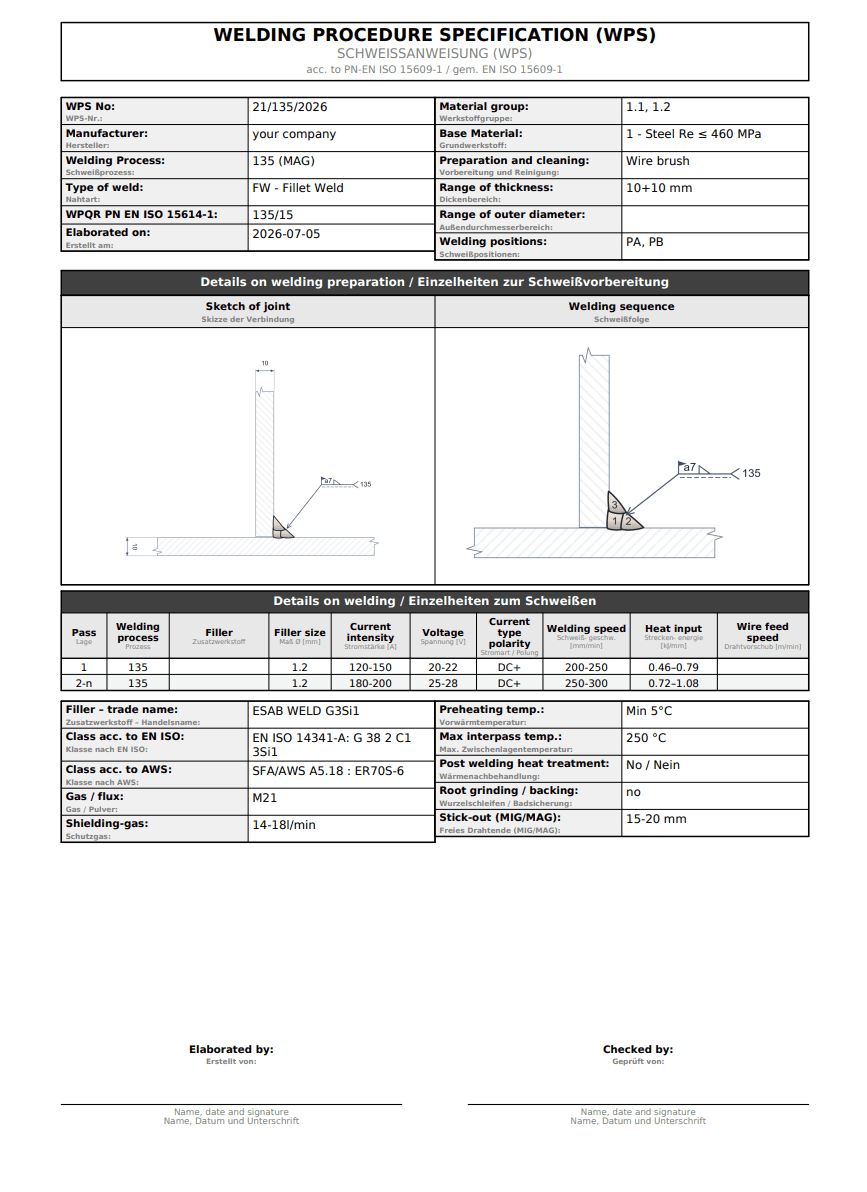
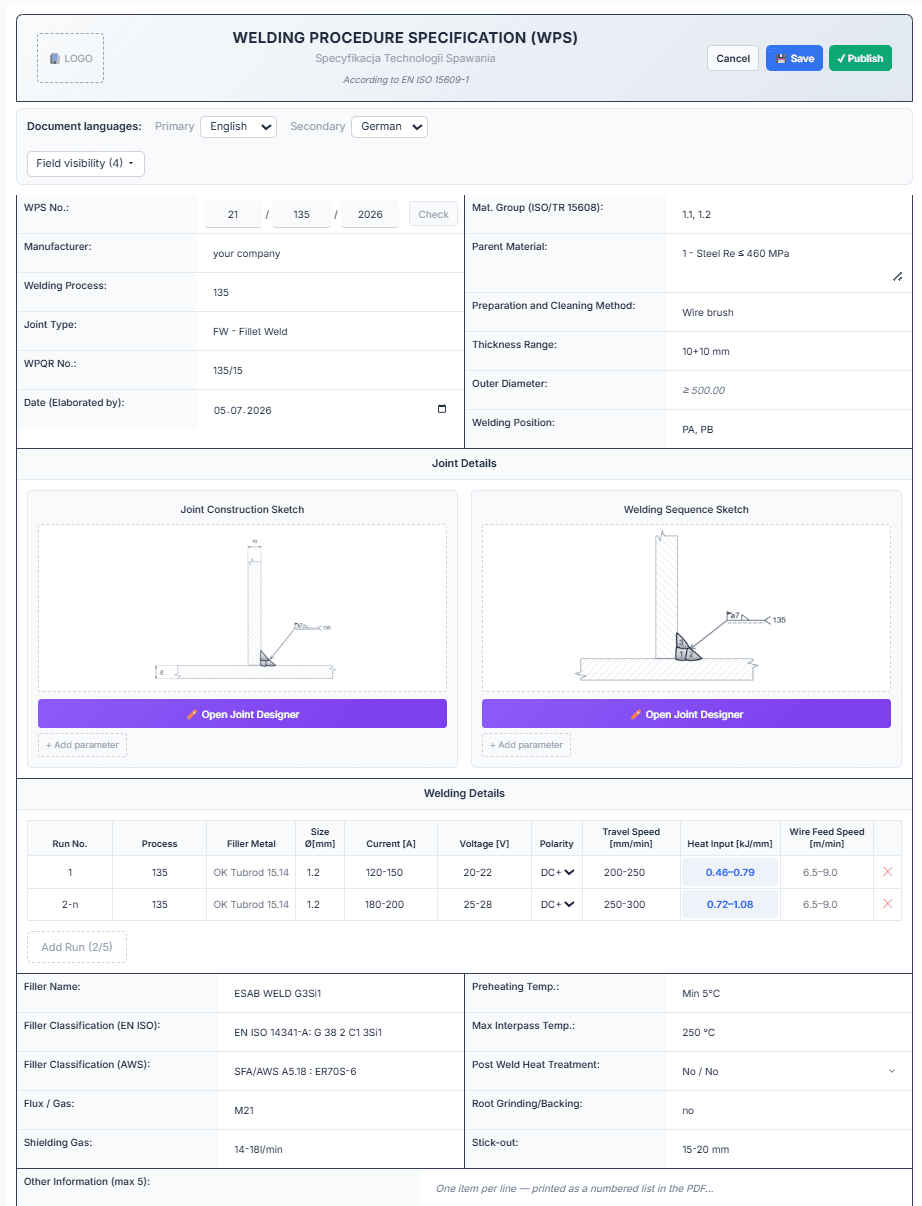
The WPS builder is laid out in the same blocks the standard asks for: identification and WPQR reference, parent material and dimensions, joint sketches, a run-by-run parameter table, thermal treatment, consumables and gas, signatures.

Material groups, not guesswork

Parent material carries its designation, its reference standard and its ISO/TR 15608 group and subgroup, so one procedure can properly cover a group of materials the way clause 4.3.1 allows.

Run-by-run parameters

Each run records process, filler and size, current, voltage, current type and polarity, travel speed, wire feed speed and heat input — the whole of 4.4.9, 4.4.10 and 4.4.17 in one table.

Joint sketches you draw, not scan

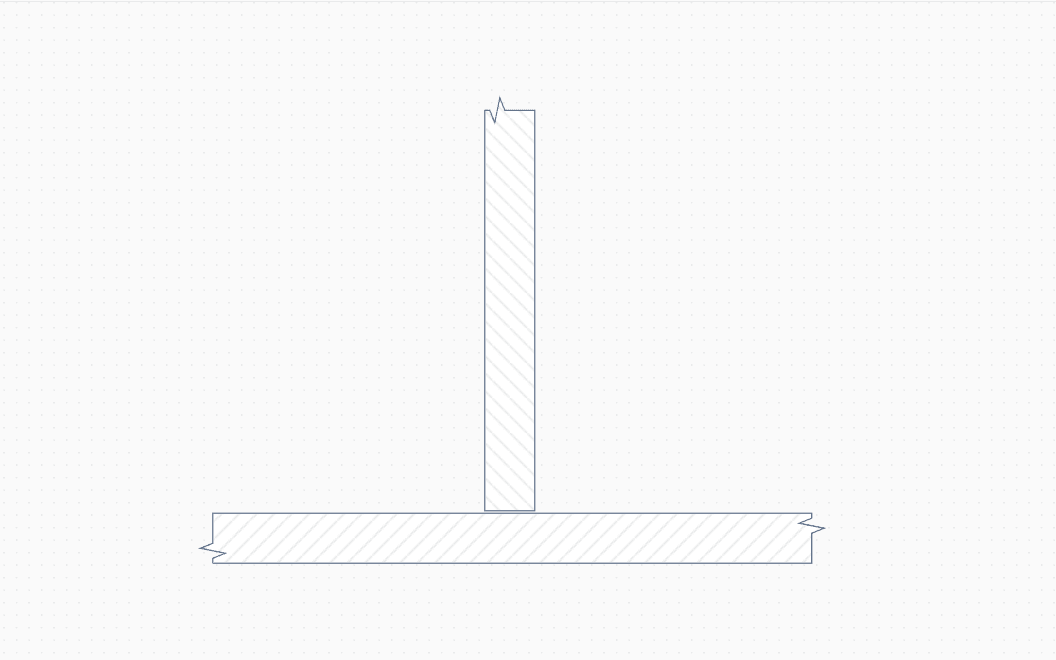
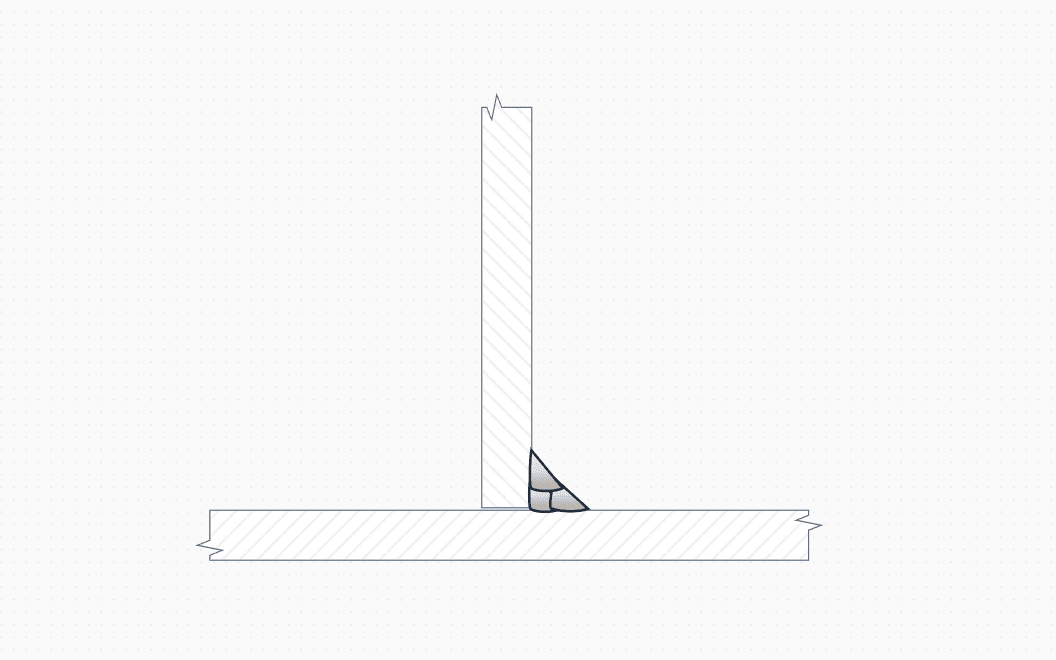
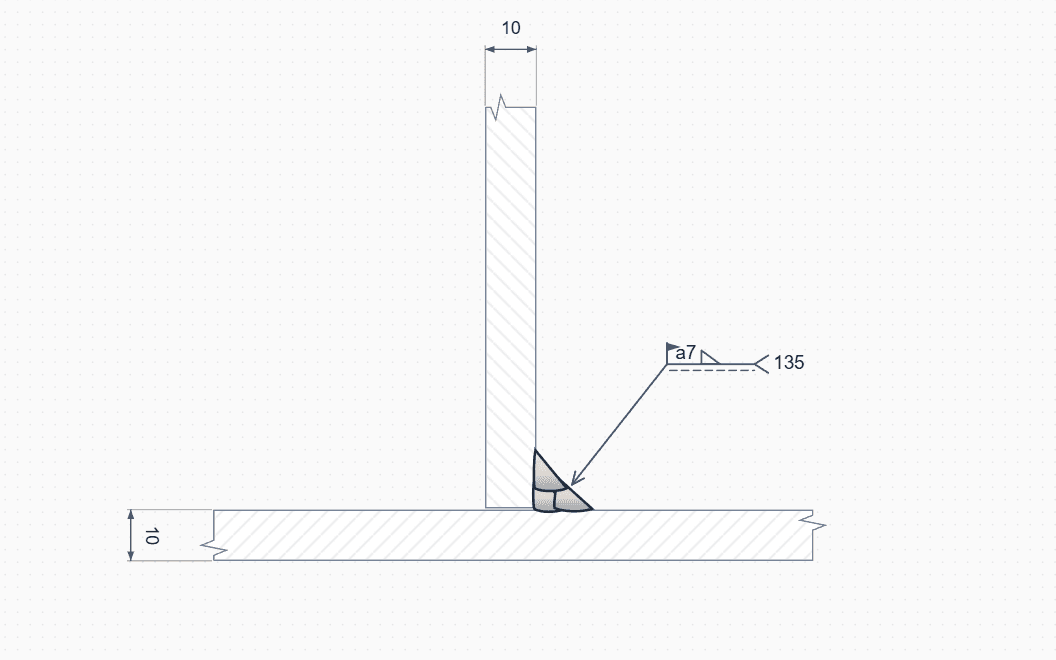
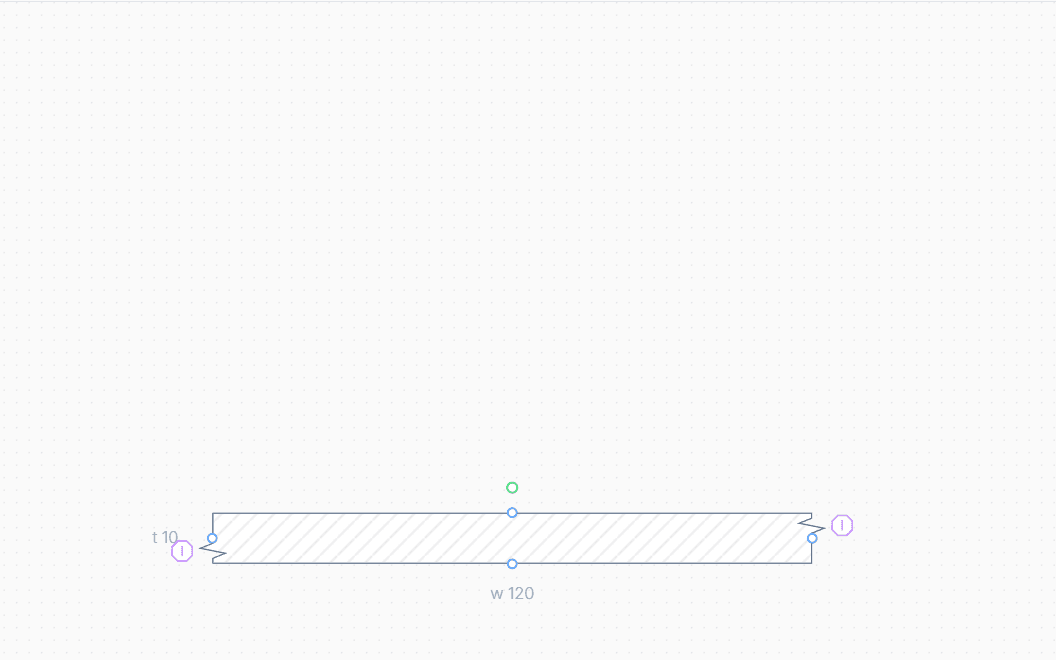
Joint design and welding sequence come from the built-in weld joint designer with their dimensions attached, so 4.4.2 is a drawing in the document rather than a photocopy stapled to it.

Bilingual PDF

Each document prints with a primary language and an optional second language underneath — Polish, English or German. One WPS that the shop floor and the client inspector can both read.

Versioning and status

Documents move draft to published to archived and carry a version number that steps up on each published revision, so the procedure a welder is holding can be traced to a specific issue.

The rest of the file

WPQR records, welder qualifications to ISO 9606 with expiry warnings, equipment, materials and inspections sit in the same system, so the WPS reference points at something real rather than at a folder on someone's desktop.

Standards the platform works to

Frequently asked questions

What is the difference between a WPS and a pWPS?
A pWPS is the procedure before it has been qualified — the recipe you intend to prove. Once the test weld has been made and tested and the results recorded in a WPQR, the procedure becomes a qualified WPS that references that record.
What is the difference between a WPQR and a PQR?
They are the same idea under two systems. The ISO route qualifies to ISO 15614 and produces a welding procedure qualification record (WPQR); ASME IX produces a procedure qualification record (PQR). Both are the evidence a WPS stands on.
Does ISO 15609-1 cover every welding process?
No. Part 1 covers arc welding. The other four parts of the ISO 15609 series cover gas welding, electron beam, laser beam and resistance welding.
Do I need a separate WPS for every steel grade?
Not necessarily. A WPS may cover a group of materials. Groups come from ISO/TR 20172, 20173 or 20174 depending on the region the material is standardised in, and from ISO/TR 15608 where a material is not assigned in those.
Does the 2019 edition invalidate WPSs written to the 2004 one?
No. New specifications should be prepared to the current document, but the standard explicitly does not invalidate specifications made to former standards or earlier editions.
Is heat input mandatory on a WPS?
The standard calls for the range of heat input, or of arc energy where that is what has been specified, in line with ISO/TR 18491. The two are different quantities and the WPS should be clear about which it states.
Do I need software to write a WPS?
No — a WPS can be a form. Software earns its place when you have enough procedures that revision control, WPQR traceability and consistent output start costing real time.
Free WPS template

A blank welding procedure specification laid out the way our own WPS builder prints it. Heat input calculates itself from the process number, and the sheet is set up to print on a single A4 page. No sign-up, no email address.

Download the WPS template (XLSX)

Opens in Microsoft Excel, LibreOffice and Google Sheets. Spreadsheet formulas only — no macros. You get the file in the language this page is set to.

Write your next WPS against the standard, not against a blank page

WeldStack gives you the WPS builder, WPQR records, welder qualifications and equipment in one system. Free trial, no credit card.